

Infrastructure transforms cities and contributes to the quality of life

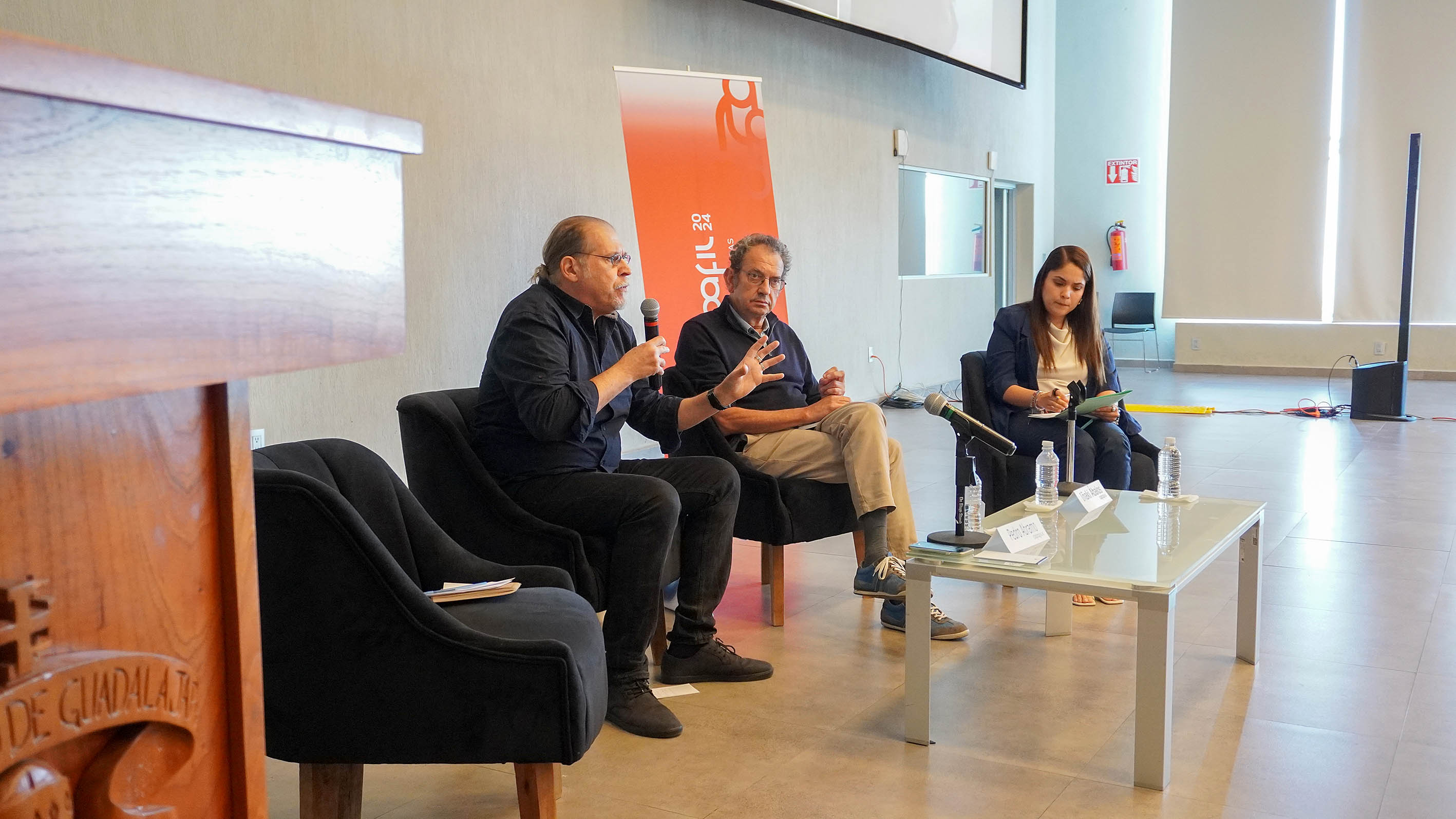


On Wednesday morning, in the Ignacio Díaz Morales auditorium of the University Center for Art, Architecture and Design (CUAAD) from UdeG And within the framework of ArpaFIL 2024, the keynote conversation “The role of infrastructure in the construction of the city” took place, in which Pedro Abramo, PhD in Urban Economics from the Ecole des Hautes Etudes en Sciences Sociales (EHESS) in Paris, and Iñaki Ábalos, Professor of Projects at the Higher Technical School of Architecture of Madrid (ETSAM) participated and visiting critic at the Harvard University Graduate School of Design (GSD). The question rounds were moderated by Dr. Alejandra Villagrana Gutiérrez, a faculty member at the school.
“There was no better way to open these activities than with the conversation with the two honorees of ArpaFIL 2024,” said Juan Angel Demerutis Arenas, Director of the Design and Projects Division of CUAADThis led to the start of the discussion. Pedro Abramo is the winner of the Jorge Camberos Garibi Medal, and Iñaki Ávalos will be honored with the ArpaFIL 2024 Tribute. Both awards are sponsored by this institution and will be presented during the 38th Guadalajara International Book Fair (FIL) on December 5th and 6th at 18:00 PM in the Juan Rulfo Auditorium at Expo Guadalajara.
During the first round of questions, it was concluded that infrastructure allows the city to be transformed and the quality of life to increase; it is not independent of the city's design and part of it invites us to be citizens and to have a home.
“For at least three or four decades now, infrastructure has been a tactical element of architecture, not only for drinking water and other elements, but also because it constitutes public space, builds realities, and transforms the city without being focused on the visual,” Iñaki mentioned.
Abramo shared several examples of pre-colonial infrastructures, to show that they have been linked to basic human needs since then; requiring energy, water and waste systems, which are basic factors in today's contemporary society.
Regarding the infrastructure of Latin American cities, Abramo pointed out that it is “highly unequal due to policies,” since these are places where, due to high population demand, they have become informal settlements, mostly concentrated on the periphery. This leads to the development of what are known as “self-built infrastructures,” which require neighborhood improvement programs. He suggested, therefore, that a mitigation policy is needed to care for and rebuild these spaces.
The honorees also spoke about the importance of the architect seeing himself as the infrastructure of infrastructures: “There must be a dialogue about infrastructure, since it is not about prioritizing the beauty of the works, but seeing how these infrastructures and systems can offer us to generate beauty through them,” Ábalos mentioned.
He added that it is important not to lose sight of the fact that students should see their creative spaces as a place where, beyond a diagram, they can play, create and innovate based on the needs of these infrastructures, in order to build knowledge and maturity and thus understand them as an opportunity to generate public space and new cities.
“We need stricter discipline among technology professionals to be effective in the fight against climate change, inequality, and the problems of the megalopolis,” concluded Iñaki Ábalos.
Attentively
"Piensa y Trabaja"
“30 Years of Autonomy of the Universidad de Guadalajara and its network organization”
Guadalajara, Jalisco, December 5, 2024
Text: Emmanuel Rangel | CUAAD
Photography: Angélica Álvarez
- 207 views